The Social Knowing Gap
The emerging rate limit

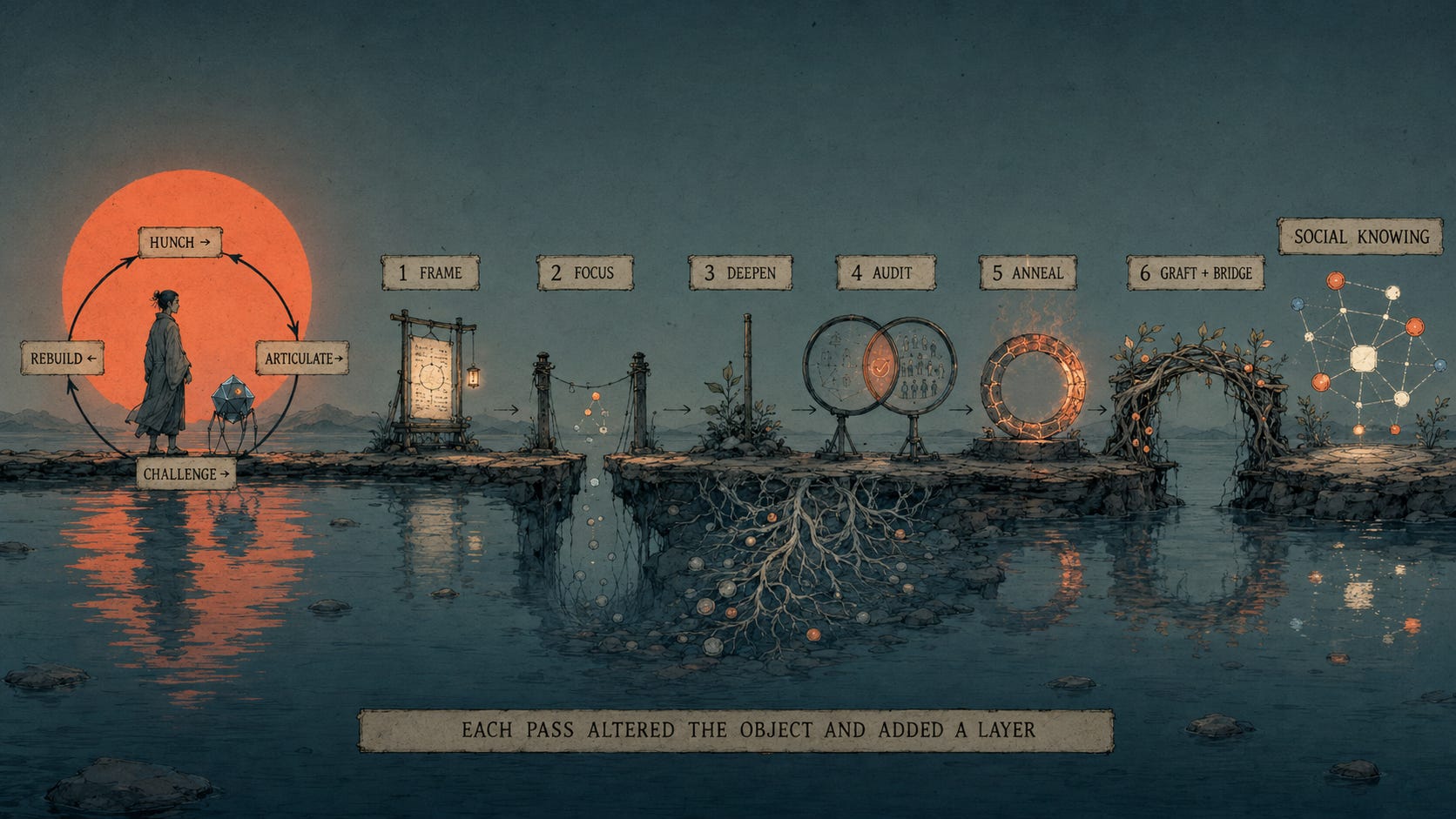
AI is changing the rate and the primary unit of knowledge production. A human–AI pair can now construct a sophisticated account of a situation, trace its causal logic, expose some of its assumptions, simulate objections and refine its expression through sustained dialogue. Tasks that once required long cycles of synthesis and drafting can increasingly be undertaken by one person working with a machine.
But an account is not the same as knowing. A claim is a proposition. An account connects claims through evidence, assumptions and inference. Knowing requires an account to be understood, inhabited, applied, tested and revised. A person does not know an account merely because they can produce or repeat it.
Social knowing is different again. It is not the aggregation of individual accounts, the circulation of a document or the achievement of apparent agreement. It is a maintained condition in which differently situated people can locate themselves around a sufficiently common object, understand how others perceive it, identify the sources of their differences and establish what has been heard, contested, provisionally accepted or left unresolved.
AI is accelerating the construction of individual accounts much faster than this social capacity is developing. The resulting divergence is the social knowing gap.
The gap is cumulative because human–AI knowing is path-dependent. Through repeated dialogue, the pair develops shared language, tacit assumptions, discarded possibilities, inferential shortcuts and a history of revision. Each exchange builds upon the last. Private context compounds.
When the final account is circulated, everyone else receives the endpoint without having traversed the epistemic journey that made it intelligible. The conclusions travel, but much of the path does not. Others must reconstruct the account’s language, premises and causal structure before they can properly encounter it. The pair compounds context; the group inherits context debt.
Meanwhile, the originating pair continues to move. By the time others have interpreted one version of the account, the pair may already have produced several more. Social knowing is therefore not merely slower than individual articulation. It is attempting to comprehend an object that is continually moving away from it.
The problem becomes deeper when the knowledge is consequential. Transformative knowledge rarely asks people merely to add another fact to what they already know. It carries a double burden: it must establish a new claim and alter the conditions through which that claim can become intelligible.
Beneath every account sit assumptions about what is true, relevant, possible and legitimate. Beneath those assumptions sit deeper gravities of comprehension: inherited categories, lived experiences, established causal intuitions and settled judgements about what deserves attention. These gravities determine which evidence is noticed, which questions appear meaningful and which explanations feel plausible.
Knowledge does not enter a neutral field. It encounters a field already structured by prior ways of seeing. A new account may therefore be internally coherent yet socially unavailable. For others to recognise it, they may need not only to follow its logic but to expose, extend or revise some of the structures through which they currently perceive the situation.
This is why knowledge must be grafted onto experience.
Experience is not simply anecdotal material. It contains accumulated pattern recognition, embodied consequence and tacit learning. For an account to become operative knowing, it must encounter this experiential substrate. It may reflect experience by giving language to something already sensed. It may extend experience by connecting it to a wider causal structure. Or it may challenge experience by revealing that what appeared self-evident was partial, local or misinterpreted.
The same account will not graft identically for everyone. Each person encounters it through a different history of exposure, practice, vulnerability and attention. What appears obvious to one person may be almost imperceptible to another because their pathways through reality have been different.
A point of view is therefore more than an opinion. It is a pathway of encounter with the world. It carries forms of evidence, attention and tacit knowledge that may be unavailable from elsewhere. The variation between perspectives is not noise to be eliminated. It is part of the epistemic material through which the situation can be more fully known.
Social knowing is consequently not the mass reception of a common account. It is a process of mass multi-agent grafting: enabling knowledge to encounter many experiential pathways and then constructing bridges between the different knowings that result.
Bridging does not require those knowings to be merged. It makes them mutually traversable. It allows people to understand where another account attaches to experience, what it reflects or challenges, which assumptions give it coherence and why it carries particular gravity for the person holding it. A functioning bridge preserves the provenance of a perspective while making its relationship to other perspectives intelligible.
Social knowing must also create space for hunches. A hunch is a directional perception that does not yet possess a publicly inspectable chain of warrant. It may register that something is absent, misframed or structurally wrong before that perception can be expressed as a defensible claim.
A hunch may reveal an unmodelled variable. It may also reproduce fear, attachment or bias. It should therefore be given standing without automatically being granted validity. The social field must allow hunches to enter as questions, provisional hypotheses or invitations to investigate. A process that recognises only finished arguments will exclude precisely those weak perceptions from which genuinely new knowledge may emerge.
The movement from individual accounts to social knowing can therefore be understood through four operations. Articulation makes an account expressible. Grafting connects it to situated experience. Bridging makes differently rooted knowings mutually legible. Annealing makes their underlying structures capable of revision.
Annealing is the critical final movement. In metallurgy, annealing does not add more material. It changes the internal structure of the material. Metal is heated, held and cooled so that accumulated stresses can relax and its structure can recrystallise. It becomes less brittle and more capable of being worked without fracture.
Social knowing requires an analogous process of epistemic annealing. Assumptions must be exposed to sufficient challenge to become movable, but not in conditions that immediately produce fracture or defensive hardening. Counter-evidence, unfamiliar experiences and unresolved hunches introduce disturbance. Hearing provides the holding condition in which those disturbances can be encountered. Reflection, return and revision allow a different structure of comprehension to form.
Annealing is not consensus. A socially annealed field may still contain profound disagreement. Its achievement is that the disagreement becomes more accurately located. Participants can distinguish conflicts of evidence from conflicts of interpretation, assumptions from values, and failed comprehension from genuine incompatibility.
Nor does social knowing require everyone to occupy the same epistemic state. A person may have heard an account without finding it credible. They may recognise it as fairly represented without considering it adequately evidenced. They may regard it as worth testing without believing it justifies action. They may accept the case for action without consenting to the proposed action itself.
These states—hearing, recognition, credibility, testability, actionability, consent and commitment—must not be compressed into agreement. Social knowing makes their distribution visible. It allows a group to know not only what is shared, but what remains contested, absent or conditional. Its objective is structured and revisable dissensus, not the performance of unity.
Without grafting, bridging and annealing, repeated argument can produce the opposite result. Knowledge that cannot graft remains abstract. Knowledge grafted only to the producer’s experience becomes private coherence. Multiple grafts without bridges become fragmented perspectives. Bridges without annealing enable mutual description but no transformation. Annealing that erases experiential provenance produces conformity rather than collective intelligence.
AI can intensify these failures. It can generate immediate rebuttals, integrate counter-evidence and simulate criticism. But the originating person still largely determines the context, vocabulary and criteria of adequacy. An account can appear to have been adversarially tested while the boundaries of the test remain defined by the account itself.
Simulated objection is not equivalent to encountering another situated knower. Another person can introduce an experience the originating frame does not recognise, refuse its categories or withhold recognition altogether. That independent alterity is precisely what a private human–AI dialogue cannot reproduce on its own.
Without such encounters, positions can become work-hardened. Every challenge generates a defence; every defence strengthens the internal coherence of the account. The position becomes more resistant, but also more brittle and less capable of revision. AI may therefore make each account more sophisticated while making the relationships between accounts progressively less navigable.
A further asymmetry follows. Producing a persuasive account is becoming cheap; interpreting, validating and socially integrating it remains expensive. When an account seeks collective attention or action, the producer captures the benefit of articulation while transferring much of the processing burden to others. This is an epistemic externality.
As accounts proliferate, groups accumulate epistemic review debt. They respond by ignoring most claims, selecting them through status and familiarity, mistaking polish for validity or forcing premature convergence. The result may be fragmentation into mutually sealed positions or false agreement around language whose underlying meanings remain incompatible.
Institutions can consequently become rich in analysis while poor in shared situational awareness. Documents, recommendations and scenarios circulate faster than common fields of comprehension can form. Communication is mistaken for understanding, consultation for encounter and assent for ratification. The institution knows more in aggregate while becoming less able to establish what it actually knows together.
The required knowledge form must therefore change. The final object cannot be only a polished document. It must preserve enough of the reasoning path for others to enter it; expose its claims, evidence, assumptions and uncertainties; allow different experiences and hunches to graft onto it; make disagreements and cruxes visible; distinguish hearing from agreement; and record the conditions under which positions would change. A long text may remain one rendering of this field, but it cannot remain the field itself.
The relevant measure is no longer simply the quality of the account. It is the change in the collective epistemic state. Has the common object become more navigable? Have hidden assumptions and gravities become visible? Have different experiential pathways entered the field? Are the disagreements more accurately located? Are the revision conditions explicit? Can the account now be tested and changed by those who did not produce it?
Social knowing does not guarantee truth. A group can understand itself perfectly and still be wrong. The shared field must remain answerable to evidence, consequences and reality. But without social knowing, even valid knowledge may remain collectively unusable because no credible pathway exists through which it can be grafted, encountered, tested and revised.
The social knowing gap is therefore not the distance between what one person knows and what everyone else has read. It is the widening distance between our capacity to forge coherent accounts and our capacity to graft those accounts onto plural experience, bridge the knowings that result and anneal them into a collectively navigable field.
Without infrastructures for this work, AI risks industrialising private coherence while leaving society progressively less capable of knowing together or making together
Indy — you're describing something I've been working on from the other side of.
The substrate underneath your four operations is the actual field condition between people — how close, how much trust still there, whether repair can happen between them or needs something outside. That condition determines which of your operations is even structurally available. Bridging doesn't work on a field that can no longer carry it. Annealing requires a holding condition that only trust provides.
What I think is missing from the piece is agreement.
Not apparent agreement. Not forced convergence. Real agreement — the group's working decision on the best available explanation for how the external world behaves, based on outcomes and what has been found useful in the doing. That's not a failure of social knowing. It's what social knowing is for. Your "structured revisable dissensus" is the process. Agreement is when the process produces something you can act on together.
Plausibility at the individual scale is personal sensemaking — you finding something credible enough to hold. At the collective scale, plausibility is the group deciding this is good enough to move on. That's a decision, not a collapse. It's the same mechanism, operating at a different level.
And you always hold yourself apart. Not as a failure to bridge — as the permanent condition that makes any contribution real. You bring your own conceptions into the field. That's what gives the dialogue something to work against. The holding-apart is what produces the friction that allows grafting to happen at all. You don't dissolve into the common object. You stand somewhere specific in relation to it. The understanding of difference — even where agreement doesn't form, even where it stays contested — can itself be the ground for moving forward.
On the independent alterity point — I think you're right, and I want to be honest about it rather than qualify it away. An AI can simulate objection within the vocabulary the account has already established. Another person can refuse the vocabulary entirely, withhold recognition, introduce experience the frame doesn't recognise at all. That's not a matter of pace or care in how the dialogue is run. It's structural. Even careful, slow, adversarially-tested AI work can't reproduce the moment someone simply won't accept your terms. That's a real limit, not an overstatement.
What follows from it is your point about the reasoning path — the final object can't be just the polished account. For others to actually graft onto it, enough of the path has to remain visible. What was assumed, what was discarded, where the pressure came from, what changed. I've been trying to do this in the structure of my own pieces — not just the conclusion but the process that produced it — but your epistemic externality point lands as a real check: the producer still captures the benefit of articulation while others absorb the processing cost. Making the path visible reduces that asymmetry, but it doesn't close it. The cost of reconstruction still falls outside.
I don't know what the full infrastructure looks like. But I think it starts there — not after the account is finished, but built into how it's constructed from the beginning.
Analytical framework and arguments are mine. AI assisted as a dialogic field — pressure, pattern, candidate language. All judgments are my responsibility.